 Ava Everhart
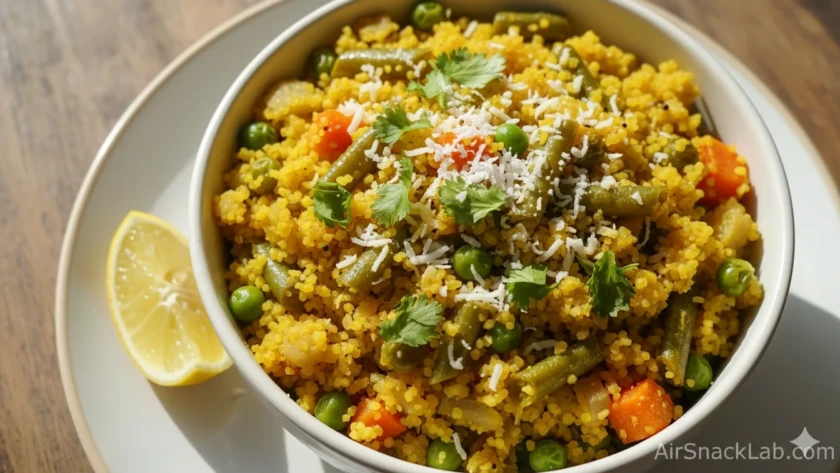
 When you think of a cozy South Indian breakfast, a warm bowl of rava upma is usually somewhere near the top of the list. It’s simple, quick, and endlessly comforting—soft semolina cooked with onions, vegetables, curry leaves, and a gentle tadka of mustard and cumin seeds.
If you’re new to Indian cooking, this rava upma recipe is a perfect place to start. It uses ingredients you can find almost anywhere, and it comes together in less than 30 minutes. Think of it as a savory semolina porridge: light, fluffy, and full of flavor.
At AirSnackLab.com, we love breakfast recipes that are:
- Easy to make on busy weekday mornings
- Nourishing and comforting, like something from home
- Flexible enough to add your favorite veggies or spices
This rava upma recipe ticks every box. Let’s walk through what rava is, how to roast it correctly, and exactly how to make a soft, non-sticky sooji upma every time.
Love Indian breakfasts? Don’t miss our full collection of Indian breakfast recipes on AirSnackLab for more ideas like poha, upma, idli and dosa.
What Is Rava Upma?
Rava upma is a traditional South Indian breakfast made with:
- Rava / Sooji / Semolina – coarse wheat granules
- A tadka (tempering) of mustard seeds, cumin seeds, curry leaves and chilies
- Onions and mixed vegetables
- Water, salt and a little fat (oil or ghee)
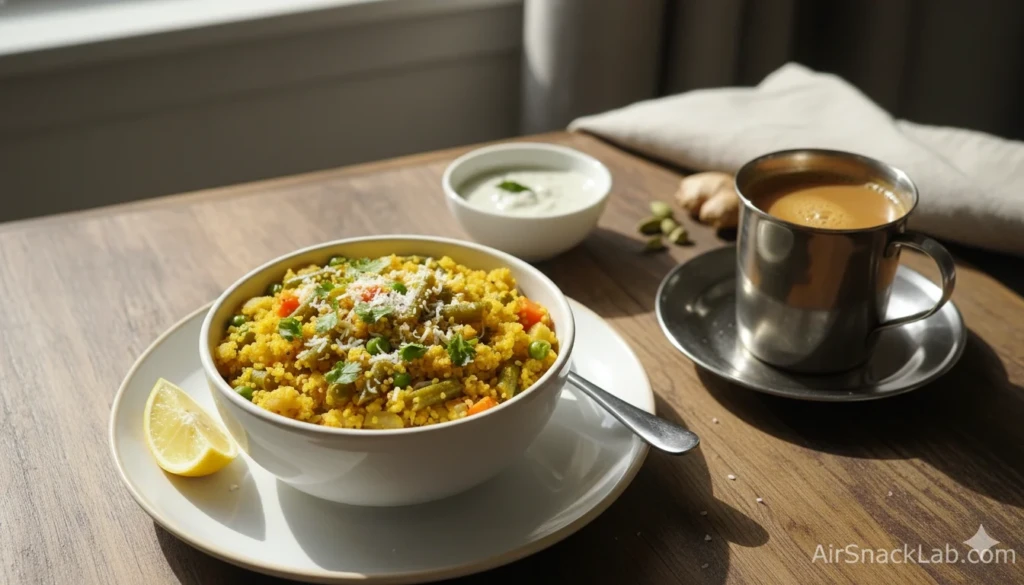
The result is a savory dish that’s soft, moist, and lightly spiced. It’s often served with:
- Coconut chutney
- Pickle
- A hot cup of chai or filter coffee
You’ll also hear people call it:
- Sooji upma
- Semolina upma
- Vegetable upma (when loaded with veggies)
In many homes, this rava upma recipe is the go-to breakfast when you want something warm and filling, but don’t want to spend a lot of time in the kitchen.
Why You’ll Love This Rava Upma Recipe
There are many upma variations, but this rava upma recipe is especially great because:
- ✅ Beginner-friendly – clear steps, no complicated techniques.
- ✅ Customizable – add or skip vegetables as you like.
- ✅ Quick – ready in about 25–30 minutes.
- ✅ Light but filling – perfect for breakfast or a light lunch.
- ✅ Vegetarian and easily made vegan (just use oil instead of ghee).
Once you learn this basic semolina upma method, you can play with flavors, toppings and textures to match your taste.
Ingredients for Rava Upma Recipe
Main Ingredients
- 1 cup rava (semolina / sooji), preferably regular or coarse
- 2 tablespoons oil (or a mix of oil and ghee)
- ½ teaspoon mustard seeds
- ½ teaspoon cumin seeds
- 8–10 curry leaves
- 1–2 green chilies, finely chopped
- 1 small onion, finely chopped
- 1 teaspoon grated ginger (optional but recommended)
- 2½ to 3 cups water (depending on how soft you like your upma)
- Salt to taste
Vegetables (Customize as You Like)
Use ½–¾ cup of mixed veggies, for example:
- ¼ cup carrots, finely chopped
- ¼ cup green peas (fresh or frozen)
- ¼ cup green beans, finely chopped
- ¼ cup capsicum, finely chopped (optional)
You don’t need all of them—use whatever you have. The idea is to make this vegetable upma colorful and more nutritious.
For Garnish
- 2–3 tablespoons fresh coriander leaves, chopped
- 1–2 tablespoons fresh grated coconut (optional, traditional South Indian touch)
- 1 tablespoon lemon juice (to taste)
- Roasted cashews or peanuts (optional, for crunch)
How to Roast Rava for Upma
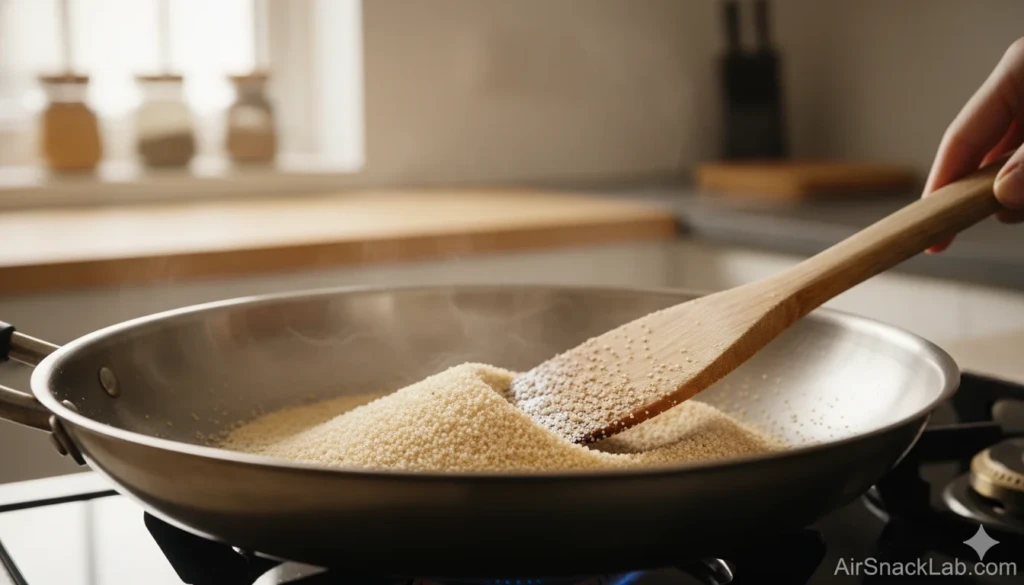
One of the most important skills in any rava upma recipe is roasting the rava correctly. It should be fragrant and lightly golden, not raw or dark brown.
- Heat a dry pan
- Place a wide pan on low to medium heat.
- Add 1 cup rava to the dry pan (no oil yet).
- Roast gently
- Roast the rava, stirring constantly with a spatula.
- Make sure it doesn’t sit in one place too long or it may brown.
- Watch for aroma and color
- After 4–6 minutes, the rava will turn slightly off-white to light golden.
- You’ll smell a nutty, toasted aroma.
- The grains should feel separate and dry, not sticky.
- Cool slightly
- Transfer the roasted rava to a plate or bowl and set aside.
You can also roast a larger batch of rava and store it in an airtight container for quick upma mornings. Using roasted rava is key for a fluffy, non-lumpy semolina upma.
Step-by-Step Rava Upma Recipe
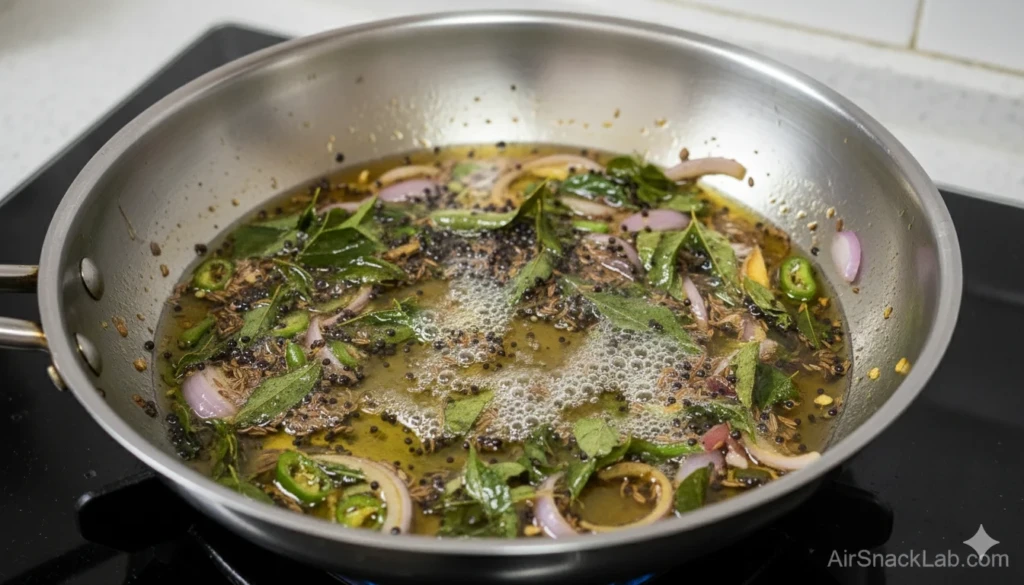
Step 1 – Prepare the Tadka (Tempering)
- In the same pan, heat 2 tablespoons oil (or 1 tbsp oil + 1 tbsp ghee) on medium heat.
- Add mustard seeds and let them splutter.
- Add cumin seeds and allow them to sizzle for a few seconds.
- Add curry leaves, green chilies, and grated ginger.
- Sauté for 30–40 seconds until fragrant.
This tadka forms the flavor base of your rava upma recipe. Take your time here so the spices bloom but don’t burn.
Step 2 – Cook the Onions and Veggies
- Add the chopped onion to the pan.
- Sauté until the onions turn soft and translucent, not deeply browned.
- Add your mixed vegetables – carrots, peas, beans, capsicum (or whatever you’re using).
- Sprinkle a tiny pinch of salt over the veggies.
- Cook for 3–4 minutes, stirring often, until the vegetables start to soften but still have a little bite.
If you’re short on time, you can:
- Use frozen mixed vegetables directly.
- Cover the pan for a minute or two to help them cook faster.
Step 3 – Add Water and Seasoning
- Pour in 2½ to 3 cups water into the pan with the veggies.
- For softer, more porridge-like upma, use closer to 3 cups.
- For a slightly firmer upma, use 2½ cups.
- Add salt to taste. Start with about ¾ teaspoon and adjust later.
- Bring the water and vegetables to a gentle boil.
Taste the water—it should be slightly salty, because once you add the rava, the seasoning will balance out.
Step 4 – Add Roasted Rava Slowly
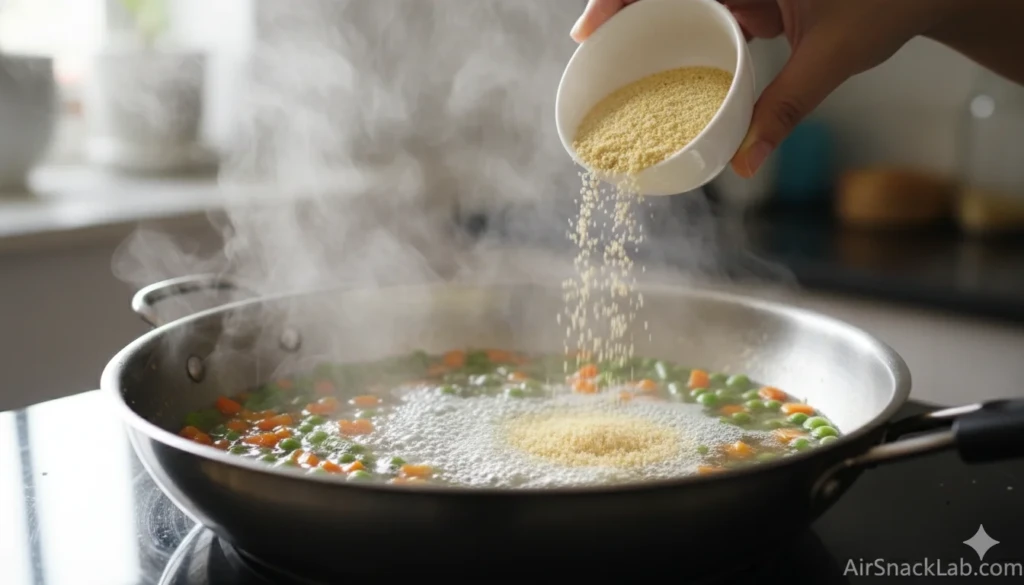
This is the most crucial step in the rava upma recipe to avoid lumps.
- Reduce the heat to low.
- With one hand, slowly sprinkle the roasted rava into the boiling water in a steady stream.
- At the same time, continuously stir with your other hand using a spatula or whisk.
Tips to avoid lumps:
- Don’t dump all the rava at once; add it gradually.
- Keep stirring as you add, so the rava spreads evenly in the water.
- Make sure there are no visible dry patches of rava.
As you add the roasted semolina, you’ll see the semolina upma start to thicken quickly.
Step 5 – Steam and Fluff the Upma
- Once all the rava is mixed in, keep stirring for another 1–2 minutes.
- Cover the pan with a lid and let the rava upma steam on low heat for 3–4 minutes.
- Turn off the heat and let it rest (covered) for another 2 minutes.
After steaming:
- Remove the lid.
- Use a fork or spatula to fluff the upma, breaking any small lumps and making sure the grains are soft and separate.
At this stage, this rava upma recipe should give you a dish that is moist, soft, and not sticky.
Step 6 – Finish with Garnish and Lemon
- Turn off the heat (if you haven’t already).
- Add lemon juice to taste (about 1 tablespoon or ½ lemon).
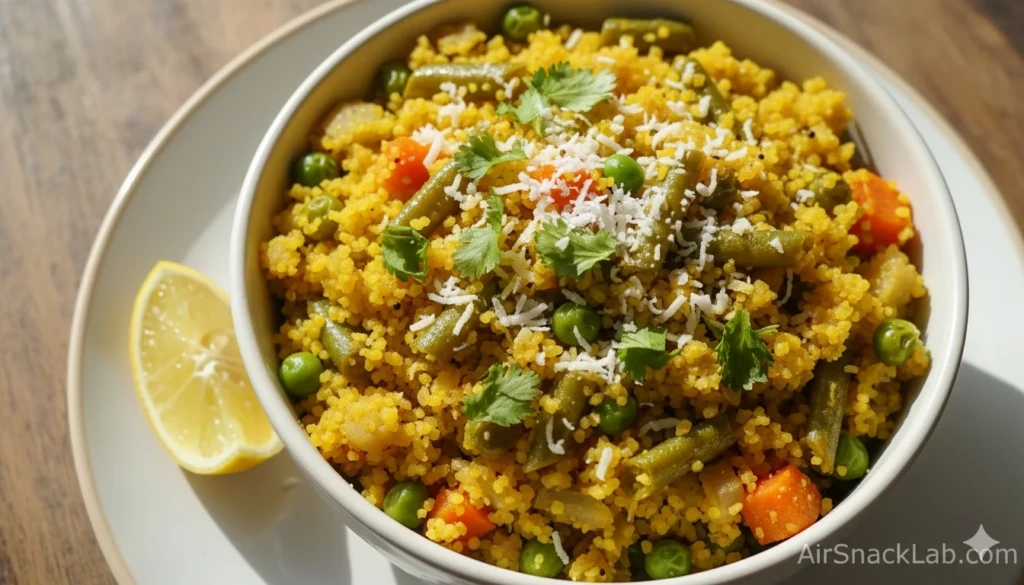
- Sprinkle chopped coriander leaves over the upma.
- Add grated coconut on top if you’re using it.
- Toss gently to mix the garnish without mashing the upma.
You can also top your vegetable upma with a few roasted cashews or peanuts for extra crunch.
Rava Upma Recipe in Simple Hindi (Upma Kaise Banate Hain?)
If your audience also searches in Hindi, you can explain upma kaise banate hain like this:
- Pehle rava ko ek sukhi kadhai mein halka sona hone tak bhun lo.
- Dusri kadhai mein tel garam karke rai, jeera, curry leaves, hari mirch aur adrak ka tadka lagao.
- Isme pyaz aur sabziyan daal kar 3–4 minute tak bhun lo.
- Ab pani aur namak daal kar ubalne do.
- Ubale hue pani mein halka-halka karke bhuna hua rava daalte jao aur saath-saath chammach se hilate raho taki guthliyan na bane.
- Dhakkan dekar 3–4 minute dum par pakao. Nimbu ras aur hara dhaniya daal kar garam-garam serve karo.
You can include a short Hindi paragraph like this in your post if it fits your style and audience.
Tips for Perfect Rava Upma Every Time
Here are a few practical tips to make this rava upma recipe fool-proof:
- Roast the rava thoroughly
- Under-roasted rava can make the upma sticky or lumpy.
- Properly roasted rava gives a fluffy texture and nutty flavor.
- Use the right rava
- Regular or slightly coarse rava works best.
- Very fine rava can make the upma pasty.
- Control the water ratio
- For soft, slightly loose upma: use about 3 cups water per 1 cup rava.
- For firmer upma: use 2½ cups water per 1 cup rava.
- Don’t rush the addition of rava
- Adding all the rava at once can cause lumps.
- Sprinkle slowly while stirring continuously.
- Adjust fat and vegetables
- A little extra oil or ghee makes the sooji upma richer and softer.
- More veggies make it colorful and healthier.
Variations of This Rava Upma Recipe
Once you’ve mastered the basic rava upma recipe, you can switch it up in many ways:
1. Plain Rava Upma (No Veggies)
- Skip the vegetables completely.
- Just use onions, chilies, curry leaves, and rava.
- This makes a simple, quick upma recipe for very busy mornings.
2. No-Onion Rava Upma
For those who avoid onions:
- Leave out the onion and increase the amount of ginger and chilies for flavor.
- Add cashews or peanuts for extra texture.
3. Ghee-Rich Upma
- Replace some or all of the oil with ghee.
- This version of semolina upma is more aromatic and tastes very homely.
4. Vegan Rava Upma
- Use only oil (no ghee).
- Skip any dairy-based toppings.
- Everything else stays the same—your rava upma recipe is naturally vegetarian and easily vegan.
5. Kids’ Friendly Upma
- Make the dish mild by using fewer green chilies.
- Add sweet corn and small cubes of carrot and potatoes.
- Drizzle a tiny bit of ghee before serving to make it extra tasty for kids.
Rava Upma Calories and Nutritional Info
This rava upma recipe is fairly balanced when made with moderate oil and plenty of vegetables.
Approximate nutrition per serving (assuming 4 servings from this recipe):
- Calories: ~230–260 kcal
- Carbohydrates: ~35–40 g
- Protein: ~6–7 g
- Fat: ~7–9 g
- Fibre: ~3–4 g
These are estimates and will vary based on:
- The amount of oil or ghee used
- The quantity and type of vegetables
- Any nuts (cashews/peanuts) added on top
Is Rava Upma Healthy?
- Semolina provides carbohydrates and a little protein.
- Vegetables add fiber, vitamins and minerals.
- Using minimal oil keeps the overall calories reasonable.
For most people, a serving of vegetable upma can definitely fit into a balanced breakfast or light meal when combined with fruits, chutneys or yogurt.
Serving Suggestions
Here are some easy ways to serve this rava upma recipe:
- With a side of coconut chutney or green chutney.
- With a spoon of pickle for extra tang.
- With plain yogurt or raita for more protein.
- With a cup of masala chai or filter coffee for a classic South Indian breakfast vibe.
Leftover upma can be reheated the next morning:
- Sprinkle a little water on top.
- Cover and heat gently in a pan or microwave until warm.
- Fluff before serving.
FAQ – Rava Upma Recipe
1. Why is my upma sticky?
- Rava might not have been roasted enough.
- Too much water may have been added.
- Rava could be very fine instead of regular or coarse.
2. Can I make rava upma recipe without roasting the rava?
Roasting is highly recommended. Unroasted rava often turns sticky and pasty. For the best sooji upma, always use roasted semolina.
3. Can I use instant rava?
If you buy pre-roasted rava, you can skip the roasting step, but still toast it lightly for better flavor. Adjust water carefully, as some instant ravas absorb water faster.
4. Can I make this upma ahead of time?
Rava upma is best fresh, but you can:
- Roast rava and store it in a jar.
- Chop veggies in advance.
Then the actual cooking part is very quick.
Rava Upma Recipe (Savory Semolina Breakfast) | AirSnackLab
Ingredients
Instructions
- Step 1 – Roast the Rava
- Add 1 cup rava to a dry pan.
- Roast on low–medium heat, stirring continuously.
- Roast for 4–6 minutes until it turns slightly off-white/light golden and smells nutty.
- Transfer roasted rava to a plate and set aside.
- Step 2 – Make the Tadka (Tempering)
- In the same pan, heat 2–3 tbsp oil (or oil + ghee) on medium heat.
- Add ½ tsp mustard seeds and let them splutter.
- Add ½ tsp cumin seeds and let them sizzle for a few seconds.
- Add 8–10 curry leaves, chopped green chilies, and 1 tsp grated ginger (if using).
- Sauté for 30–40 seconds until fragrant.
- Step 3 – Cook Onions and Veggies
- Add the chopped onion to the pan.
- Sauté until the onions turn soft and translucent.
- Add your mixed vegetables (carrot, peas, beans, capsicum).
- Sprinkle a small pinch of salt over the veggies.
- Cook for 3–4 minutes, stirring often, until the vegetables start to soften (they don’t need to be fully cooked yet).
- Step 4 – Add Water and Season
- Pour in 2½–3 cups water into the pan with the veggies.
- 3 cups = softer, looser upma
- 2½ cups = slightly firmer upma
- Add salt to taste (start with ~¾ tsp and adjust later).
- Stir and bring the mixture to a gentle boil.
- Step 5 – Add Roasted Rava (Slowly!)
- Lower the heat to low.
- With one hand, slowly sprinkle the roasted rava into the boiling water in a thin stream.
- With your other hand, stir continuously with a spatula or whisk while adding the rava.
- Keep going until all the roasted rava is added and mixed, with no dry patches or big lumps.
- Step 6 – Steam and Fluff
- After mixing, keep stirring for 1–2 minutes as the mixture thickens.
- Cover the pan with a lid and cook on low heat for 3–4 minutes.
- Turn off the heat and let it sit covered for 2 more minutes.
- Open the lid and gently fluff the rava upma with a fork or spatula so the grains are soft and separate.
- Step 7 – Finish with Lemon and Garnish
- Add lemon juice to taste (about 1 tbsp or ½ lemon).
- Sprinkle chopped coriander leaves on top.
- Add grated coconut and a few roasted cashews/peanuts if you like.
- Mix gently and serve hot.

Notes
- Enjoy